
The Fragmented Consumer
How Speed, Distraction, and Delivery Are Redefining the Grocery Trip

Do you ever feel like you're constantly going to the store to buy groceries? If so, you're not alone. There is a trend toward consumers shopping for groceries more often but spending less time in each trip. The conventional wisdom is that this trend is driven by budget-constrained consumers shopping more stores to deal-hunt and spending less. That is definitely a part of the answer, but not the entire picture. The reality is there are several factors changing how we shop. And that shift in behavior is going to become more pronounced as consumers adopt agentic commerce.
We’re Shopping More Often
The time consumers spend per grocery visit has remained significantly lower than the pre-COVID era, while trip frequency is up—29% of Americans shop for groceries two or three times per week and 18% shop four to six times weekly.
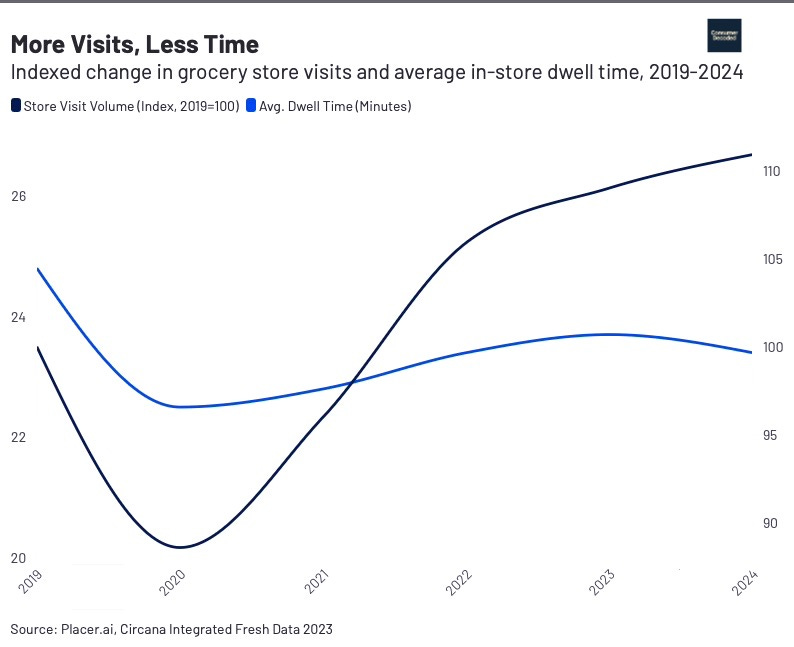
Many attribute this to economic stress, and there is evidence supporting that idea—consumers are going to more stores to find the best deal and are willing to shop around for a discount. A study by the Hartman Group found that 60% of shoppers visit multiple stores to find the best deal. But that’s only part of the equation, and the other factors have very little to do with saving money.
The Distracted Consumer
Consumers are also shopping more frequently for quick trips because they are forgetting things even though they still, largely, shop from lists. Somewhere between 60 and 80% of consumers have a shopping list when they go to the grocery store, but they frequently divert from it—50% of grocery shoppers make unplanned purchases on any given trip.
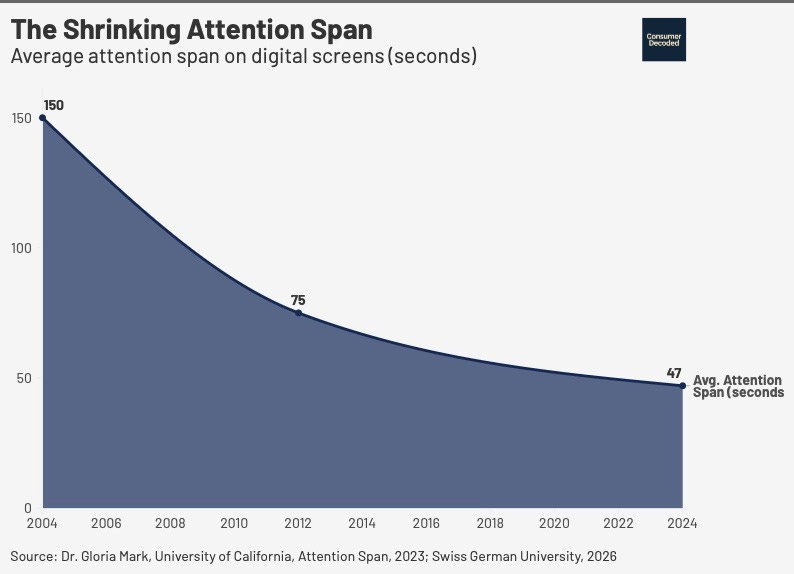
While consumers have always been attracted to end caps and special promotions in-store leading to additional purchases, our level of distraction and ability to focus is a growing reason for shopping off list and forgetting things. According to Dr. Gloria Mark, attention spans on any screen have decreased from two and a half minutes on average to around 47 seconds in the last few years—a 68% decline. At the same time, smartphone multi-tasking has increased by 84% since 2016. A growing body of research shows that excessive phone use is associated with structural changes in the brain, particularly in areas responsible for attention, decision-making, and impulse control. In other words, even when we are making that list, there is a good chance that we are forgetting items because we are multi-tasking or distracted.
The sage advice to avoid over-spending by never going to the store hungry needs a modern corollary: never going to the store post-scrolling.
The Need It Now Mindset
The third driver, and possibly the biggest one, is the rise of quick commerce—that is, grocery delivery within one to three hours of placing an order. What was once a premium convenience is becoming a baseline expectation, and that shift is happening rapidly.
Part of the reason for this increase is simply the availability of this option. Instacart pioneered same-day grocery delivery at scale beginning in 2012. It has taken time to scale and the pandemic was a major accelerator.
In the span of roughly a decade, the infrastructure that made same-day grocery delivery possible went from a novelty to a near-universal offering.
But availability alone does not explain the adoption curve. What we are seeing is a pattern where platforms expand availability, consumers adapt their expectations upward, and those elevated expectations are now pulling demand forward regardless of any further logistics improvements. The consumer who once accepted a two-day delivery window for a bag of pasta has recalibrated to a two-hour window.
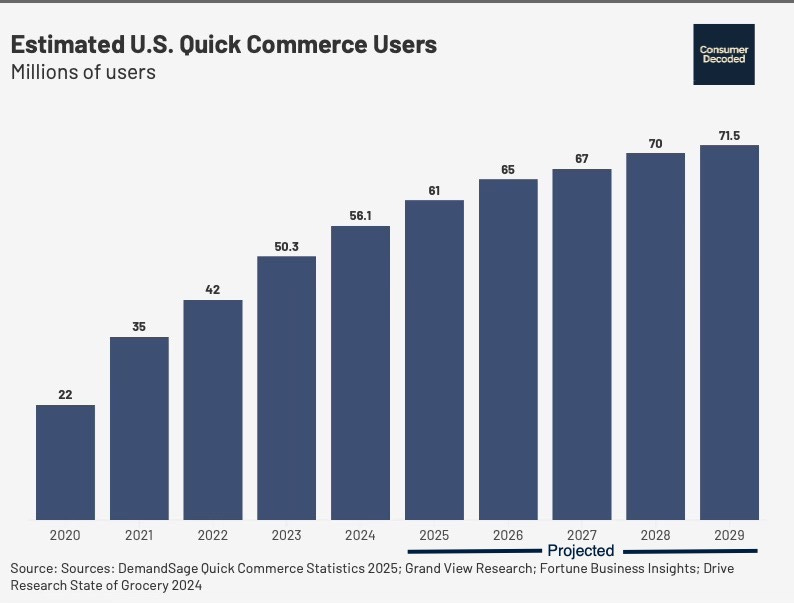
The adoption numbers reflect that shift. Grocery delivery service usage rose 56% between 2022 and 2024. Quick commerce is growing rapidly, as shown in the chart above. Globally, the adoption rate is much higher than in the US. And the expectations that came with that adoption have reset the consumer’s frame of reference: nearly 77% of consumers now expect delivery within two hours, according to quick commerce market surveys. That expectation did not exist five years ago.
Paving The Way For Agentic Commerce
There is still a healthy amount of debate about whether or not consumers will transact through agents, referred to as agentic commerce.
What is clear is that consumers have already shifted and are continuing to shift, how they buy—buying in a more fragmented way, becoming more comfortable with delivery, and developing a firm expectation that they can get just about anything delivered within a couple of hours.
These are all foundational behaviors that will facilitate agentic commerce, particularly for routine items and anything that is “I need it now”—the toilet paper that just ran out, the snack item that your child suddenly needs for school tomorrow, or the item that you forgot to get for your recipe when you were at the store.
What It All Means
When we look at all of these drivers at the same time, it is not at all surprising that we are seeing more frequent, smaller trips in grocery retail—and that trend is here to stay. Even if consumers get economic relief and feel comfortable spending more at the store, they are likely to remain distracted, leading to forgotten items, and they are increasingly likely to turn to delivery apps for some of their shopping trips. All of these factors, in differing combinations for different consumers, explain more frequent, shorter grocery trips in the aggregate.
For brands, the implication is that the in-store dwell time that once drove discovery is decreasing—and with it, the exposure time that planogram placement, promotional mechanics, and in-store media depend on. A shopper who spends 23 minutes in the store is simply not the same shopper as one who spent 25. The margin on that two minutes is where a significant share of unplanned trial used to live.
For retailers, the challenge is holding a shopper whose definition of convenient is accelerating toward a less than two-hour delivery window, even for a handful of items. And for both brands and retailers, the distracted, fragmented consumer is not a pandemic-era artifact that will revert to prior norms.
If these patterns continue at their current trajectory, we are entering a period where the grocery trip as a concept is being disaggregated. What was once a single, weekly ritual is fracturing into a portfolio of behaviors across channels, formats, and time horizons. The retailers and brands built around the stock-up trip will need to rethink both their economics and their relationship with a consumer who is, increasingly, not making a trip at all.
Interesting Reading:
“American Snacking Habits Are Transforming the Restaurant Industry,” March 3, 2026, The Atlantic.
“How A Music Streaming CEO Built An Open-Source Global Threat App In His Spare Time,” March 5, 2026, Wired.
“Anthropic’s Ethical Stand Could be Paying Off,” March 7, 2026, The Atlantic.