
Will AI Make Being a Mom Any Easier?
Mothers may automate more—and yet feel compelled to do even more themselves

I regularly chat with a colleague of mine who has young children and she almost never complains about the basic, everyday tasks of motherhood. But what will really get her going are the surprise things that come up—the forgotten homework, the child crawling in bed at 2 am or the sick kid that requires a major schedule change. . . and her school’s mom group chat—the epicenter of performative parenting.
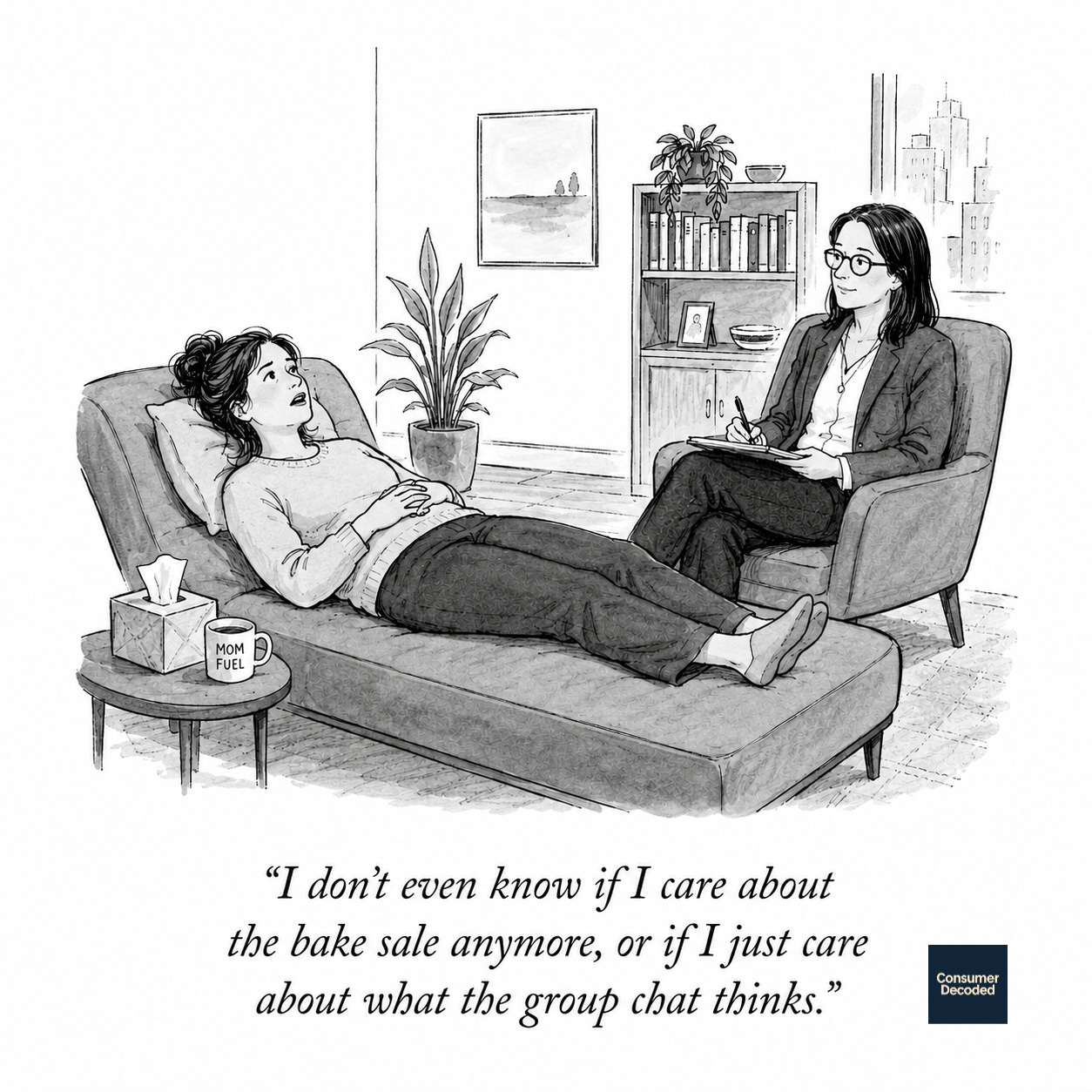
Even though my kids are largely out of this stage, I can relate. Confession: I have never looked at the online gradebook for either of my children except for report cards, which apparently is freakishly abnormal. I have been a mom for two decades now and I am here to tell you that the pressure to perform as a mom is real and AI may only make that worse.
The Hope for AI
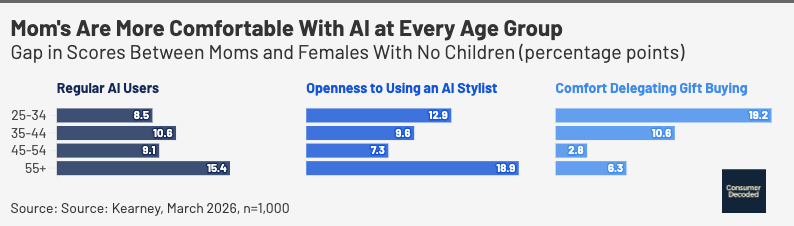
Moms are excited about AI. In a recent Kearney study, we found that moms at every age group were more likely than non-moms to use AI—they are more familiar with it, more likely to use an AI stylist, and more likely to use AI for gift suggestions. Moms are looking for help managing it all. In our recent survey of working moms, balancing work and family, managing household logistics and mental health and burnout were their top concerns—way above childcare costs and career advancement.
We Have Seen This Before
In the early days of the smartphone, the promise was connection and flexibility. Working mothers would stay closer to their children when at the office and they could handle family logistics from anywhere. All of that was true.
Also true: the smartphone introduced always-on work expectations into the home. It handed working mothers a device that made them reachable at all hours—which meant they were. It created the pressure to perform, to document, and to curate a version of family life on social media that looks nothing like the actual experience. In effect, it replaced one version of stress that came from being physically at a desk to get work done with another—the mental stress of ‘always on, always perfect’ culture. The flexibility was real but so was the new tax.
The IKEA Effect of Motherhood
Much like mobile phones introduced new mental health challenges by normalizing a completely abnormal, perfected version of motherhood, there will be knock-on impacts of AI.
There is a well-established behavioral economics finding called the IKEA effect. In a 2012 paper in the Journal of Consumer Psychology, Michael Norton, Daniel Mochon, and Dan Ariely demonstrated that people consistently overvalue things they’ve made themselves—even when made badly, even for utilitarian products, even when they’d objectively prefer an expert’s version. The effort creates the value.
Motherhood is full of IKEA moments.
The Sunday meal prep that nobody asked for, but that communicates I know what this family needs. The birthday cake that took three hours and looked nothing like the picture. Remembering—without being reminded—that your kid has a big test on Thursday. These aren’t inefficiencies to be automated away. They are, for many mothers, a currency of care—the way they feel and express care for their family.
Academic literature often refers to mom guilt as compensatory over-performance. When mothers delegate—to a babysitter, a meal kit, now an AI agent—guilt redirects energy rather than reducing it. A 2019 diary study found that on days working mothers felt guilty about time spent at work, they demonstrably over-invested in parenting the following day to compensate. The delegation creates guilt, which, in turn, generates more labor.
A 2018 study in the Journal of Marketing Research by Leung, Paolacci, and Puntoni found that consumers who strongly identify with a particular role actively resist automation that prevents them from attributing outcomes to themselves. When the outcome is central to your identity, you want to have done it. Automated fishing rods, automatic cooking features, self-driving cars—people who identify as fishermen, cooks, and drivers reject them, not because they’re worse, but because credit matters. Competence expressed through effort is part of what makes the identity real.
This will create an interesting dynamic for moms in the future. A large number are likely to delegate tasks that are routine and not associated with care. Having groceries automatically delivered at the right time reinforces an identity of caring for the family and being a savvy household manager. But, they may also take on more labor-intensive tasks that could be easier. One mom may bake the birthday cake that could be ordered from the local bakery while another may choose to plan her family’s meals instead of turning to AI because it is part of what she believes being a good mother is.
What This Means for Brands and Retailers
I have written a lot about how important meaning and identity will be in an agentic commerce world. Unless you are expecting to compete on transactional measures like price and speed, it is essential for your brand to differentiate on meaning and identity. Notably, brands that successfully anchor in identity tend to command structurally higher margins.
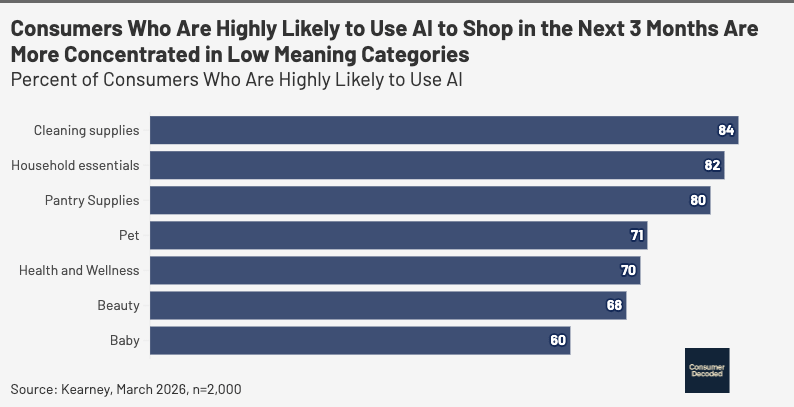
We already see resistance to automation in high identity categories in the data. Consumers are far less willing to delegate decisions in categories like baby and beauty. Not because the decisions are more complex, but because they mean more. The act of choosing is part of the value.
Most brands don’t measure this. They have hundreds of product attributes—price, size, ingredients, speed—but almost no articulation of meaning. What identity is this product helping the consumer express? Where does the effort itself carry value? Where does the customer want to feel like the one who did it?
Those are not soft questions. They are where margin will be captured.
In practice, this requires a shift in how brands think about design, assortment, and experience. Retailers and brands need to embrace 5 elements to create an identity premium:
Segment categories and brands by identity, not just economics. Some categories will fully commoditize under agent optimization. Others will resist—not because they are immune to AI, but because consumers don’t want to fully delegate them. Treat those categories and sub-categories differently. If you are not the low price leader in a commoditized category, look for ways to create meaning.
Identify the moments where authorship matters and recognize where it will be different by consumer group. In some cases, the consumer doesn’t just want a good outcome—they want to feel like they were the one who created it. Those moments should not be fully automated, and innovation will come from understanding that consumers will view this differently within the same category. As illustrated below, four different moms could get equal meaning and validation from four different approaches to procuring a birthday cake. Understanding which version of identity you are validating is critical.

Preserve effort where effort creates meaning. The instinct will be to remove friction everywhere. That will be the right move in many cases. But in others, the effort is the point. Making those experiences faster risks stripping out the value unless you let the consumer experience it elsewhere. As an example, bakery cakes need to include an online design component or design library to allow the consumer to participate in getting the details right, not just a point and click option.
Build meaning into the product, not just the messaging. Consumers don’t just buy identity—they practice it. The product experience itself should reinforce the role the consumer wants to play. If your product takes effort out of the occasion, the experience should reinforce that time savings through savings cues and the mental effort that has gone into the task.

AI will make motherhood more efficient, but not easier. Easier implies less weight, but the weight of motherhood is not in the tasks. It is in the responsibility of showing up, in the right way, at the right moment, for the right person. No agent can exactly replicate that. The brands that understand that distinction—and build for it—will earn something no algorithm can optimize away: genuine loyalty from a consumer who chose them, not just one whose agent defaulted to them.
My colleague who never complains about the daily grind but loses her mind over the school group chat will probably use every AI tool available to her. And she will also, I suspect, still be the one who shows up at the bake sale with something homemade. Not because she had to, but because that particular moment matters to her, and that is the whole point.
Happy Mother’s Day to all of the Consumer Decoded Moms!
Interesting Reading:
The Era of the Tiger Mom Is Over. Enter the Beta Mom. The Wall Street Journal, May 8, 2026.
Amazon Built a Massive Supply Chain for Itself. Now It’s for Hire. The Wall Street Journal, May 4, 2026.
With Just One Word, Brandeis Is Trying to Change College Shopping, The New York Times, May 10, 2026.