
You've Got AI
Looking back at the 1998 romantic comedy, "You’ve Got Mail" reveals how technology actually changes commerce—and why we may be debating the wrong things again.

My daughter is seventeen and loves a rom-com from the 1990s. As a result, we recently found ourselves watching “You’ve Got Mail,” the 1998 romantic comedy starring Meg Ryan and Tom Hanks. Of course the movie is about romance, but it is also about change. The movie showcases a number of changes to commerce—the rise of the “category killer,” the demise of the locally-owned small business and the beginning of the personalization boom that Starbucks ushered in. It also focused on how human relationships were changing. The core relationship centered on the idea of meeting a romantic partner online, exploring both the anxiety and the possibilities associated with that.
The movie speaks to a number of predictions and fears about how the technology of the day—the internet—would shape life. Watching it feels like opening a time capsule and, at the same time, the fears and possibility sound remarkably similar today. If you replace “online” with “AI” you hear many of the same anxieties and “what ifs.” Will it replace jobs? Will it weaken human relationships? Will it destroy entire industries?
While the film was right about some of those changes and wrong about others, it provides some helpful lessons for where AI will take us next, which predictions are right—and the things that we do not even see coming.
The Category Killer Got Killed
One of the driving forces of the movie was just how much commerce was changing–and, not just with technology. The late 1990s featured the rise of the “category killer” and the effect it was having on small businesses. Large specialty stores such as Barnes & Noble, Best Buy and Home Depot were rapidly expanding. Their model was straightforward: scale within a category allowed them to offer larger assortments and lower prices.
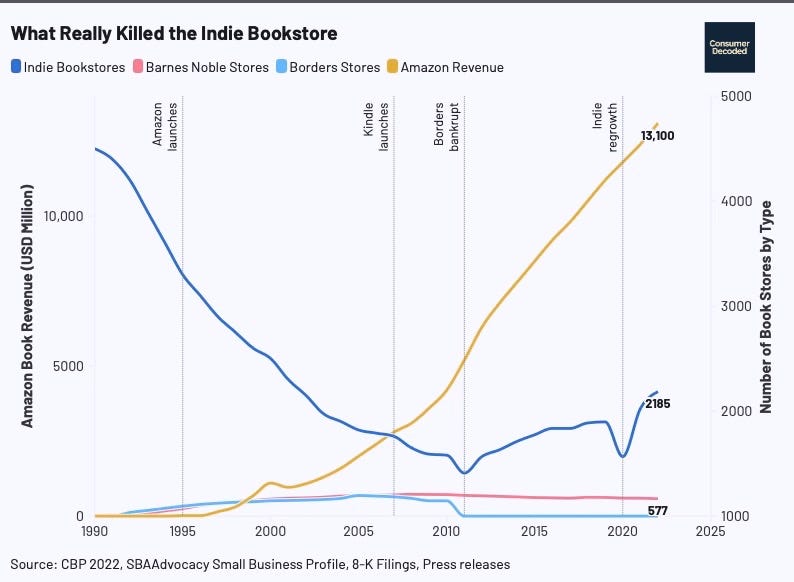
Those who feared this business model lamented the demise of the specialized knowledge of someone who had worked in a particular industry for years and really knew their craft and their local customer. Those concerns were not unfounded. From the early 1990s through the early 2000s, independent retailers declined significantly as large chains expanded.
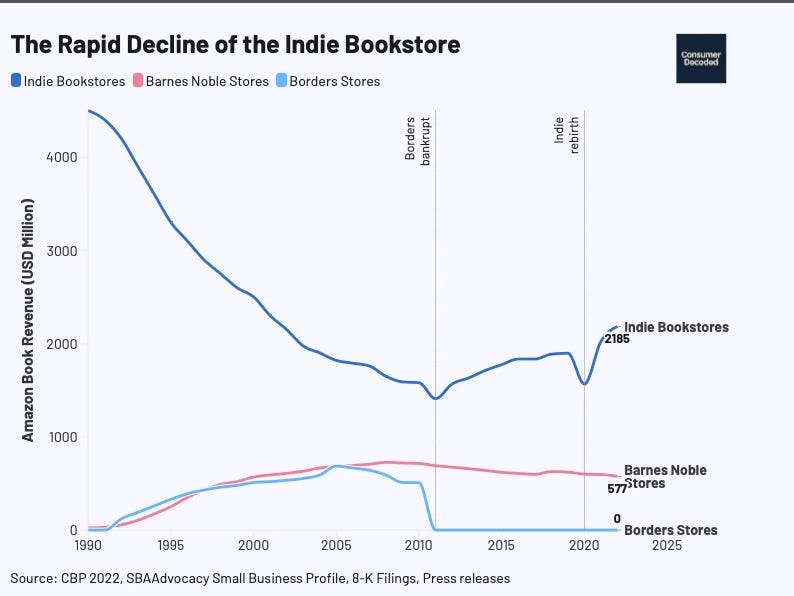
While those retail dynamics are certainly true, that is not the whole story. Ultimately, it was ecommerce, not category killers, that had the biggest competitive impact on booksellers and other retailers alike. Amazon provided part of the value proposition that Barnes & Noble and other category killers did—large selection and great prices—but it ultimately beat them on both dimensions. Meanwhile, it lacked a great browsing experience, or as the movie described it, “a piazza in the city,” but it turns out many customers didn’t care.
The Personalization Signal
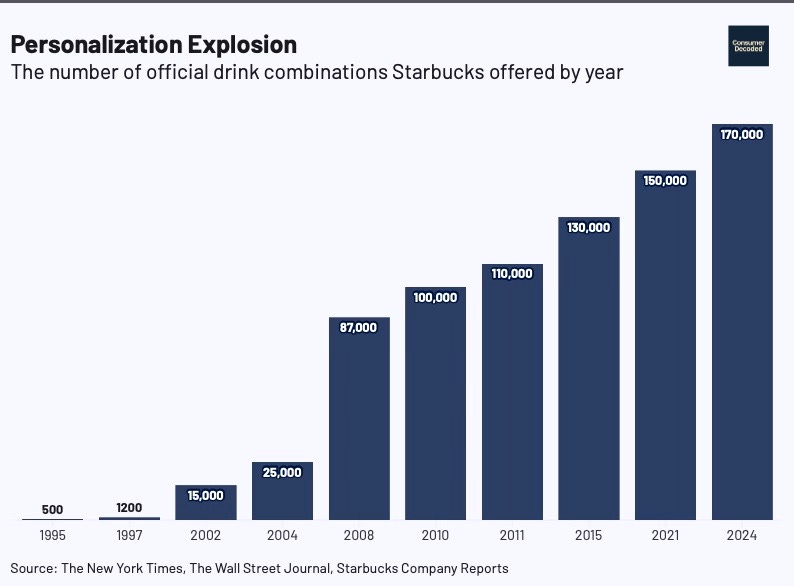
The other trend spotlighted in the movie was the rapid expansion of Starbucks and its role in hyper-personalization. Starbucks expanded rapidly during the time of the movie from well under 1,000 stores in the mid-1990s to over 10,000 stores just a decade later. This was part of the narrative—the large chain that overtook local coffee shops. But another important theme was the level of personalization that grew in the chain. In the early 1990s the primary decisions to be made on your cup of coffee were coffee type and size. This grew throughout the early 2000s and by 2008, there were 87,000 possible variations in drinks that could occur, ranging from the drink itself, size, extra flavors, toppings, type of milk, temperature of the drink, and so on.
What began as a novelty evolved into a much broader expectation that products and experiences should adapt to individual preferences.
Over the following two decades, personalization expanded far beyond coffee and is now simply table stakes in nearly every digital interaction from what we watch to what we buy. Looking back, Starbucks was an early signal of a much larger shift toward personalized consumer experiences, and perhaps most interestingly, it was an analog signal that evolved into a digital trend.
What We Didn’t See Coming
Looking back at that period, it was clear that there were early signals of where commerce was going to move—scale, convenience and personalization would all be growth drivers. But, some of the biggest changes we did not even see coming: the rise of social media, mobile phones and large platform monopolies. The biggest transformations of the internet era were barely discussed in the 1990s.
If history repeats itself, the biggest impacts of AI will not be the ones dominating today’s debate.
The Parallel To AI
We are at a similar inflection point as in the movie with some eerie parallels—technology and business model innovation were having an impact on how people lived, there was a great deal of uncertainty over how that would impact certain types of jobs and the communities we live in. Many of the same anxieties exist today as existed in the late 1990s: AI replacing workers, killing creativity, and weakening human connection.
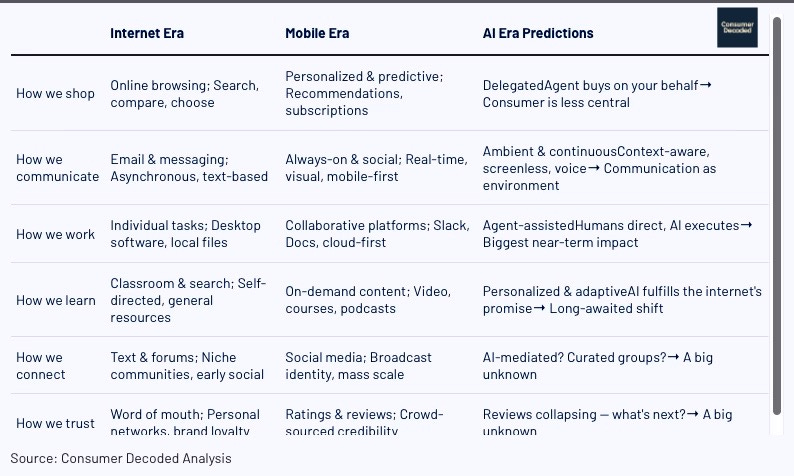
If the internet era taught us anything, it’s that the biggest transformations rarely come from the technology itself but from the ecosystems built around it. The same may prove true with AI.
The internet era offers a useful lens for anticipating where AI will take us — not by predicting specific technologies, but by looking at how entire ecosystems of behavior shifted across many dimensions of daily life. In the 1990s, the signals were there for how we would eventually shop, communicate, and connect—but the full magnitude of those shifts only became clear in hindsight. The same is likely true today. Across each of these dimensions, AI appears poised to complete a transformation the internet began—and in some cases, to take it somewhere no one is yet imagining.
The Real Lesson of “You’ve Got Mail”
A 1998 romantic comedy turns out to be one of the more useful frameworks for thinking about AI. You've Got Mail was really a film about disruption—the rise of the category killer, the personalization boom, the anxiety of meeting strangers online. Some of those fears proved right. Others were completely wrong. And the changes that ended up mattering most—social media, mobile, and platform monopolies—barely registered in the conversation at all. We are at a similar inflection point today, and history suggests we are probably debating the wrong things. The question worth asking isn't what AI will replace. It's what gets built around it that we aren't yet imagining.
Interesting Reading
“AI Isn’t Lightening Workloads. It’s Making Them More Intense,” The Wall Street Journal, March 11, 2026.
“The Uncomfortable Feeling Worth Feeling,” The Atlantic, March 7, 2026.
“In Praise of Grunt Work,” The Economist, March 11, 2026.